01
AI Training & Inference
Large language models, generative AI and enterprise AI
AI GPU Infrastructure
AI runs on physical infrastructure: high-performance GPUs, the clusters they form, the data centres that house them, and the power, cooling and connectivity that keep them operating.
Explore how AI infrastructure works, why demand for high-performance compute is growing and the infrastructure required to bring compute online.
What is AI infrastructure?
Artificial intelligence requires enormous amounts of computing power.
Much of this compute is delivered by high-performance GPUs housed within specialist data centres. These processors provide the computational power required to train AI models, run applications and process increasingly complex workloads.
Every time someone uses an AI application such as ChatGPT or Claude, high-performance compute infrastructure within data centres is performing the computational work behind the scenes.
But AI is only part of the picture. High-performance GPUs support workloads across multiple industries.
Large language models, generative AI and enterprise AI
Climate modelling, CFD and drug discovery
Risk simulation, pricing and quantitative analysis
VFX, animation and transcoding
Bioinformatics and medical imaging
Simulation, CAD and digital twins
Streaming and real-time graphics
One common requirement
High-performance compute.
Why GPUs, and why now?
AI adoption remains relatively early, yet demand for the infrastructure required to support it is already growing rapidly.
As AI moves from experimentation towards broader commercial adoption, increasingly sophisticated models and applications require greater volumes of high-performance compute.
At the same time, bringing new compute capacity online depends on several interconnected parts of the infrastructure ecosystem.
GPU supply
Advanced processors are complex to manufacture, while demand for leading systems continues to grow.
Data centre capacity
GPU infrastructure requires specialist facilities capable of supporting increasingly dense computing environments.
Power
AI infrastructure requires substantial, reliable energy capacity.
Infrastructure & deployment
Networking, cooling, connectivity and specialist operational expertise are required to deploy and maintain high-performance compute.
Demand extends beyond AI
Scientific computing, finance, engineering, healthcare, media and other established industries also require high-performance compute.
A GPU alone is not AI infrastructure. Every capability must connect before compute can come online.
AI infrastructure
Independent evidence points to an extraordinary build-out in AI infrastructure, accompanied by significant physical constraints on delivery.
NVIDIA is working with Apollo, BlackRock, Blackstone, Brookfield, Goldman Sachs and KKR to mobilise more than $500 billion of third-party capital for AI infrastructure.
Projected hyperscale and Tier-2 cloud infrastructure spending as generative AI continues to accelerate demand for compute.
More than half of US data centres planned for 2026 are expected to face delays as electrical infrastructure struggles to keep pace with development.
NVIDIA Blackwell spot compute pricing increased approximately 48% between February and April 2026, highlighting demand for constrained next-generation compute capacity.
The AI infrastructure stack
It is easy to think of AI as software. In practice, every model has to be computed somewhere — by hardware that sits in a building and draws electricity from a grid. Making that compute available is a construction and energy problem as much as a software one.
AI workload
Training a model, running inference or processing an advanced workload
GPU compute
Parallel processors performing the calculation
GPU cluster
Many GPUs operating as one synchronised system
Networking & storage
High-speed interconnect and data pipelines
Data centre
A high-density, AI-ready operating environment
Power & cooling
Grid connection, electricity and thermal management
GPU clusters & AI-ready data centres
Modern AI compute is assembled by the rack rather than the server. NVIDIA's GB200 NVL72 puts 72 GPUs and 36 CPUs into a single liquid-cooled rack whose power, cooling and internal network are designed together, and which NVIDIA describes as behaving like one very large GPU. Where clusters span multiple racks, dedicated high-bandwidth fabrics — InfiniBand or AI-optimised Ethernet — keep the GPUs from sitting idle waiting on each other.
A building either accommodates that, or has to be adapted to. Density is the dividing line: AI racks draw far more power than most existing halls were designed around, and past a certain heat load air cooling stops being practical and liquid cooling takes over. Retrofitting touches power distribution, cooling and sometimes the structure itself, so feasibility is highly site-specific.
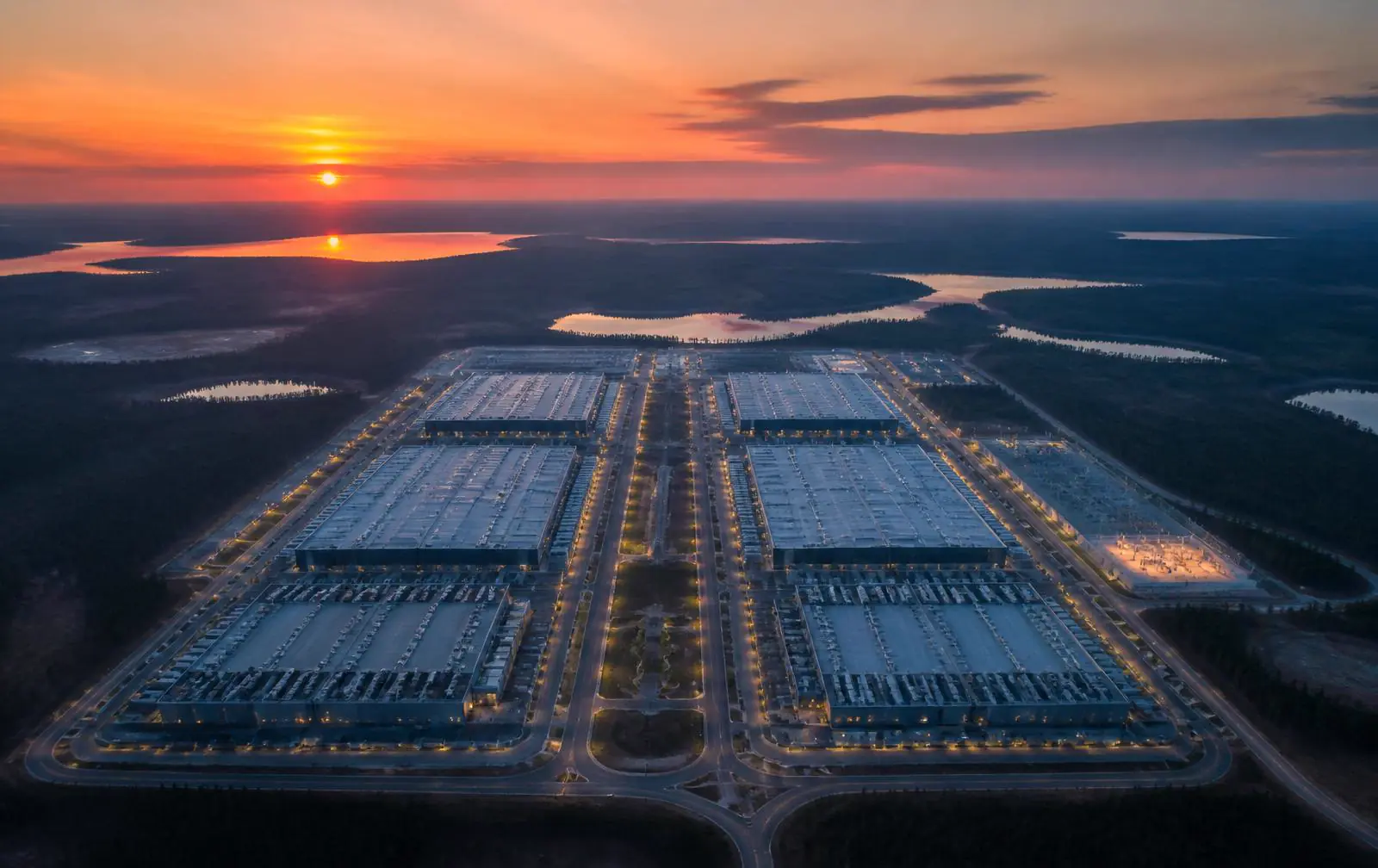
The UK government's assessment is direct: the UK has a mature data centre market that is not yet optimised for AI, because most facilities are built for general-purpose enterprise computing. What is scarce is not floor space, but AI-ready floor space. Facilities purpose-built around dense GPU clusters, liquid cooling and large, reliable power are increasingly described as “AI factories”.
Power, grid & land
Data centres used around 1.5% of global electricity in 2024, and the IEA projects that roughly doubling to about 945 TWh by 2030 — slightly more than Japan consumes today. A typical AI-focused data centre uses about as much electricity as 100,000 households; the largest under construction, twenty times that.
Power existing somewhere is not the same as power reaching a specific site on a specific date. The IEA estimates around 20% of planned data centre projects are at risk of delay from grid strain, with new transmission lines taking four to eight years in advanced economies. In Great Britain the connections queue passed 700 GW before NESO re-ordered the pipeline in December 2025 around deliverable projects.
Siting therefore comes down to a short list of practical questions: how much power can be delivered here and when, is there a route for heat rejection and fibre, will it obtain planning consent, and can grid, building and equipment all be ready in the same window. Sites that satisfy all of them at once are uncommon.
AI infrastructure in the UK & Europe
The UK Compute Roadmap forecasts a need for at least 6 GW of AI-capable data centre capacity by 2030 — around three times what is available today — supported by AI Growth Zones offering streamlined planning and prioritised grid access.
Europe is moving in the same direction through the European Commission's AI Factories initiative, with dedicated AI campuses above 1 GW now planned in the US, UAE and several European countries.
Where Nuway Capital fits
Nuway Capital identifies, develops and coordinates commercial opportunities across AI infrastructure, including direct ownership of enterprise-grade GPU compute.
Working through a network of specialist infrastructure and technology partners, Nuway brings together the capabilities required to source, deploy, manage and commercialise customer-owned GPU infrastructure.
Enterprise-grade GPU systems through specialist supply networks.
Coordinate data-centre capacity, power, connectivity and associated infrastructure.
Coordinate ongoing management, monitoring and operation of the infrastructure.
Make available compute capacity to commercial users and coordinate the resulting rental activity.
Nuway does not manufacture GPUs, operate cloud GPU services or independently operate energy infrastructure. Delivery is coordinated through specialist partners, including members of the NuSphere Alliance.
Direct GPU ownership
Nuway Capital enables customers to purchase and own specified enterprise-grade GPU infrastructure without having to independently source, deploy, manage and commercialise the equipment themselves.
The customer owns the underlying infrastructure in accordance with the contractual arrangements, while Nuway coordinates its commercial lifecycle through specialist infrastructure and technology partners.
From purchase to productive compute
Customer-owned infrastructure moves through a defined process from contractual purchase to deployed, managed and productive compute.
The customer enters into a contractual agreement with Nuway Capital for specified enterprise-grade GPU infrastructure.
Following payment, the equipment is procured through Nuway’s specialist supply network.
Nuway coordinates data-centre capacity, power, connectivity and associated infrastructure through specialist partners.
Once the agreed contractual conditions are satisfied, legal and beneficial ownership of the specified infrastructure transfers to the customer.
Under a Managed Services Agreement, the infrastructure is managed on the customer’s behalf throughout the agreed term.
Available compute capacity is rented to commercial users, generating rental income from productive use of the infrastructure.
Rental income is distributed to the customer in accordance with the contractual arrangements, net of applicable management fees and operating costs.
Research & insights
Research underpins the commercial opportunities Nuway creates.
Nuway has collaborated with KPMG on a series of research papers exploring GPUs, AI compute infrastructure and the structural trends shaping the sector.



Three research papers developed in collaboration with KPMG, available on request.
Request the researchAI GPU infrastructure FAQs
AI GPU infrastructure is the physical system that allows artificial intelligence to run: GPUs, the high-speed networks connecting them into clusters, the storage feeding them data, and the data centre, power and cooling systems supporting all of it.
AI workloads consist of very large numbers of simple calculations that can be performed simultaneously. CPUs handle a few complex tasks in sequence; GPUs handle many simple tasks in parallel, which matches how neural networks compute. Memory bandwidth and the speed of the links between GPUs matter as much as the number of processing cores.
A GPU cluster is a group of GPUs connected by a high-speed network so they function as a single computing system. Large AI models are too big for one GPU, so work is spread across many processors that must stay tightly synchronised.
An AI factory is a facility purpose-built to produce AI output at scale — designed from the outset around dense GPU clusters, liquid cooling and large, reliable power supply, rather than a general-purpose data centre with AI equipment added to it.
Chiefly power density and cooling. AI racks draw considerably more power than conventional enterprise racks, which can exceed what air cooling can handle and typically requires liquid cooling alongside reinforced power distribution and high-speed networking.
Many can, but often only after substantial upgrades. Power distribution, cooling and sometimes the building structure were sized for conventional rack loads, so supporting high-density AI infrastructure can require significant change. Whether that is practical is highly site-specific.
Power availability and grid connection are among the most significant constraints, alongside suitable sites, cooling, networking, equipment availability and project delivery. These interconnected capabilities must be ready in the same delivery window.
Nuway Capital provides customers with access to specified enterprise-grade GPU infrastructure that can be purchased and directly owned in accordance with the contractual arrangements.
No. Nuway coordinates the deployment, management and commercialisation of customer-owned infrastructure through specialist infrastructure and technology partners.
Nuway Capital
Whether you want to understand GPU infrastructure, explore direct ownership or discuss current opportunities, speak with our team.